

Strategic Questioning in Sales: Unlocking Growth Markets

Updated: Jul 6, 2025
Capturing Higher Market Shares Requires a Deeper Understanding of the Problem in the Sales Strategy & Call

Capturing Higher Market Shares Effectively Using the Buyer's Cycle & a Probing Plan
This article delves into questioning techniques in relation to the buying cycle. When growth remains stagnant over many years, it signals that an issue is not being addressed in the sales call and strategy. Gaining larger market shares and outpacing a competitor necessitates a strategy and adept questioning techniques. Capturing market shares suggests the need for a behavior change strategy, as current behaviors are hindering growth. Behavior change necessitates "awareness" of an existing problem to foster a desire to change or adopt a product. There is an 80%-90% failure rate in human behavior change. Understanding this highlights that sales require a strategy.
Uncovering Implied & Explicit Needs
Improving the sales representative's thought process and the buying cycle through effective probing techniques accelerates the buying process, aiding in closing deals. Reviewing questioning techniques to advance the buying cycle and developing datasets for salespeople to use can be an effective way to keep your salesforce skills optimized. Furthermore, enhancing customer conversions or gaining new clients requires understanding and optimizing your buying cycle by identifying your customer's current stage, which is essential for moving the call through each phase of the buying cycle.
Customer Decision Process in Sales
Several questioning techniques are listed below as best practices for coaching sales representatives. In my 20 years of experience with Fortune 500 companies across 12 organizations, I've observed that most selling models do not address the strategy surrounding the sales call, nor do they focus on coaching strategic thinking to effectively progress the sale to a close. Closing prematurely is always a poor decision. This often results from inadequate planning and a lack of understanding of the customer's current phase in the buying cycle. If the close is executed prematurely and ineffectively, it can cause the sales cycle to regress to the beginning, wasting valuable time between sales calls.
To advance progress, it's essential to craft skillful questions. Designing these questions requires a thorough understanding and analysis of the problem. The buying cycle serves as a tool to examine the stages a customer experiences before making a purchase. In coaching, I utilize the buying cycle with sales representatives to encourage them to critically assess their position with the customer within this cycle. This approach aids them in developing a strategy to advance the customer to the next stage.
The Buying Cycle & Phases
The customer decision-making process in each sale involves a series of phases progressing along a continuum. By consciously analyzing the customer and situation, the salesperson can formulate the most effective questions to advance these phases towards a conclusion. Closing prematurely can be awkward and may result in a missed opportunity. Poorly executed "closes" can cause embarrassment, make the customer uncomfortable, or require the salesperson to revert to earlier stages in the sales cycle. Since time is money, preparing for the "close" is crucial to closing effectively.
"If I had an hour to solve a problem, I would spend 55 minutes defining the problem & 5 minutes finding the solution."
Albert Einstein
(1879 – 1955), theoretical physicist
This quote highlights the necessity of grasping a problem before trying to solve it, suggesting that a precise definition is crucial for an effective solution. There are numerous simple and efficient ways to sell. In contrast to other corporate sales models, SPIN selling focuses on questioning. I believe the straightforwardness of the questioning techniques makes this approach more accessible for salespeople to adopt. Otherwise, they might overlook the significance of skilled questioning during their sales calls. The creators of SPIN selling developed this approach by analyzing 35,000 sales calls to identify what led to success and failure. The effectiveness of this method lies in its emphasis on structured questioning to reveal customer needs.
5- Stage Buying Cycle Process of Decision-making
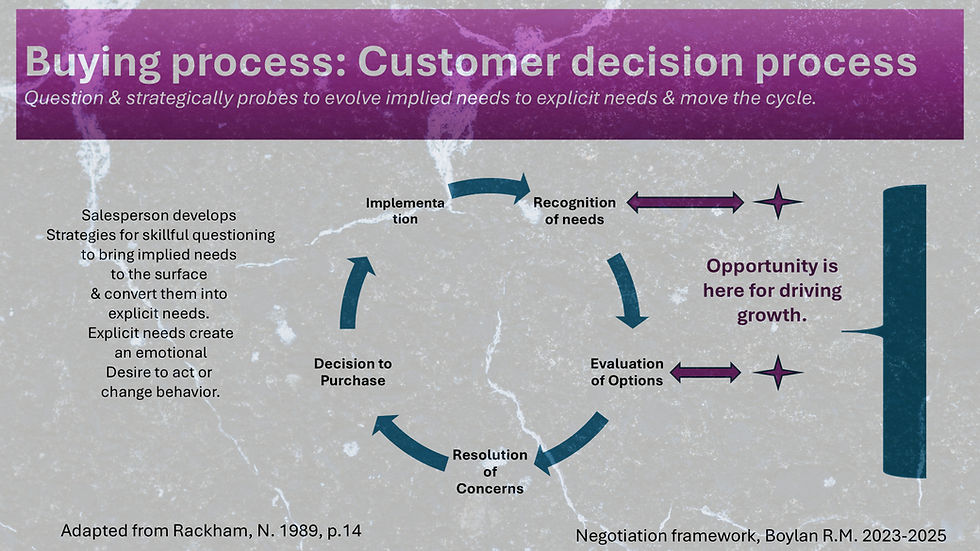
1). Awareness: "Recognition of needs phase".
2). Consideration: "Evaluation of options" and/or "Resolution of concerns" phase.
3). Intent: Making a decision to purchase or change a service.
4). Purchase: Purchasing a solution (or renewing a service or product.)
Understanding the customer decision-making process
The process a customer goes through to decide on a purchase involves several distinct stages. Three of these occur prior to making the buying decision. The fourth stage takes place after the purchase decision. The final phase presents a sales opportunity to foster customer loyalty and encourage repeat business.
Although these phases might be apparent to the sales representative, they may be overlooked or not effectively utilized to develop a sales call strategy. Lacking awareness of the phase poses a challenge in formulating strategic questions that advance the cycle. The decision process starts when a customer no longer feels completely satisfied. Therefore, dissatisfaction with the current situation and options is crucial for progressing through the buying phases.
The first of the three phases in the buying process is the "Recognition of Needs" phase. This phase is essential for creating growth opportunities in the buying cycle. During this stage, the buyer transitions from minor irritation to significant dissatisfaction. The selling process involves transforming implied needs into explicit needs, compelling the customer to take action. This leads to the "evaluation of options" and "decision to purchase/implementation" phases. In the "recognition of needs" phase, questioning techniques prompt the customer to consider, "Do I really need to change?" "Should I lease or buy?" "Is this issue truly problematic for me and the end-user?" "Why should I change?"
The best selling strategy is to sway the criteria the buyer or buyers use to evaluate their options in your favor. It's crucial to recognize that once the customer or buyer has decided, or there is a consensus within the account that change is necessary, the next phase is kickstarted "Resolution of Concerns". At this phase options are evaluated, which options meet the criteria are defined, the third and final phase, "resolution of concerns," requires the customer's decision-making criteria to match up with your capabilities, features & benefits.
At this stage, the customer might feel considerable anxiety, worry, and concern regarding the risks linked to your product, your company, or yourself. If questioning and probing techniques do not reveal these issues, they may stay hidden. This will become a blind spot if you don't address their criteria with solutions that ease their concerns.
The last phase is "Implementation." During this phase, salespeople frequently overlook the chance to sell. It focuses on assisting and supporting the account and customer in using our product or service after the sale has been completed. Developing a post-sale strategy is crucial to avoid missing opportunities at this stage. (Rackham, N. 1989, p. 4-8)

Capturing the Customer's Mindset
To avoid expending unnecessary effort in trying to sell a product to a prospective buyer, it's crucial to examine the problems within the sales process. Sales demand a strategic approach, especially when the market is stagnant. Without a clear grasp of your customer's mindset during the purchasing process, you'll end up going around in circles. To successfully win over that customer, you must first comprehend their mindset.
Analyzing the buying cycle and the phases a customer or prescriber goes through to make a purchasing decision shows that for a sale to occur, the customer must be at certain levels. If they haven't reached these stages, it's the representative's responsibility to lead them there using skillfully and strategically formulated questions. Each phase requires a unique strategy to move the customer to the next stage.
To pinpoint the problem with the sales call in a market that has experienced stagnant growth and no increase in market share, it's important to analyze the stages of the buying process. The sales call aims to move the buying process forward towards our product. When thinking about the buying process and decision-making, I believe that focusing on the
"recognition of needs phase" & "resolution of concerns" phases during the sales calls is where the greatest growth potential and market share gains can be achieved. The entire sales call strategy must be focused on this so questions and discussion is designed to move the buying process to the close.
Building the Value through Value-Creation Selling
1) Identifying dissatisfaction with current habits and using implication questions with outcomes data to emphasize this;
2) Expanding on this dissatisfaction by highlighting the implications for users if a solution is not provided;
3) Directing this dissatisfaction towards our product. Without dissatisfaction, there is no incentive for the clinician to alter prescribing habits.
Prochaska's model indicates that there is an 80%-90% rate of failure in changing behavior. To effectively alter human behavior, a tailored strategy for each customer is essential. This strategy should comprehend the stages of the Buying Cycle. Subsequently, the precall plan and questions are crafted to guide the decision-maker through the buying cycle. Unsuccessful vs. successful sales people treat implied needs & explicit needs differently. We will discuss their critical roles in shaping successful sales strategies.
In smaller sales compared to larger ones, implied and explicit needs might not appear as crucial. Nevertheless, in more complex larger sales—such as those requiring behavioral change or involving significant costs—grasping these nuances becomes essential.
Results of research on 35,000 sales calls (N. Rackham):
"Less successful people don't differentiate between "implied and explicit needs" in a sales call. They treat them in exactly the same way."
Very successful people, often without realizing they are doing it, they treat "implied needs" in a very different way than "explicit needs".
Understanding Implied Needs
Implied needs are the indirect and often unspoken requirements that customers suggest during discussions. For instance, when a buyer mentions, “We frequently experience delays with our current software,” they are indicating a need for enhanced reliability, even if they don't explicitly state it.
Recognizing implied needs is crucial, especially early in the sales process. They open the door to understanding the broader challenges that potential customers face. By identifying these implied needs, sales professionals can ask deeper questions and gather more information, setting the foundation for a comprehensive understanding of the buyer's situation.
Implied needs: Statements by the customer about problems, difficulties and dissatisfactions.
Explicit needs: Specific customer statements of wants or desires.
In negotiations, "positions" refer to the surface-level desires of the other party, whereas "interests" hold greater significance. It's crucial to understand the other side's needs during any sales call or negotiation. A "needs development strategy" should encompass the needs you already know and the questions you plan to ask to uncover deeper needs. Identifying more implied needs during a smaller sales call increases the likelihood of success. In larger sales or with buyers who have a strong preference for a competitor's product, it's necessary to delve beyond implied needs. Implied needs serve as buying signals and are the foundation for the "needs development strategy." In more complex sales calls or meetings, more sophisticated questions are needed to transition from implied needs to explicit needs.
Identifying needs is crucial for presenting a solution that leads to a sale. This can be explained by the Value equation, which refers to the magnitude of the needs compared to the cost of the solution. A sale is likely if the customer views the problem as greater than the cost of addressing it. Conversely, if the problem is minor and the cost or effort to adopt the product is higher, a sale or a switch to your product is unlikely.
Probing strategy for creating a need for the solution
Explicit needs are predictors of success in larger more complex sales. Implied needs don't predict success in larger sales, but explicit needs do. A probing strategy must begin with uncovering implied needs. The success of the call depends on how "implied needs" are developed. More specifically how are they converted by questions into "Explicit Needs".
Understanding Explicit Needs
In contrast, explicit needs are the clear and articulated requirements that customers directly express. When a client states, “I need a solution that supports 200 users without lag,” they specify a clear need. Explicit needs usually surface after exploring implied needs and are essential in the later stages of the sales process.
Explicit needs provide sales representatives with concrete criteria for tailoring their solutions. Addressing these needs effectively can significantly improve the chances of closing a sale. For instance, according to a study by the Sales Management Association, sales strategies that directly address customer needs can increase closing rates by 24%.
The Importance of Implied and Explicit Needs in the Sales Process
Understanding when to focus on implied versus explicit needs is vital for an effective sales strategy. Implied needs are the jumping-off point for discussions that reveal what keeps customers awake at night. These conversations can uncover underlying interests that might not be immediately obvious and help sales professionals propose solutions that truly resonate with potential buyers.
On the other hand, explicit needs add clarity. They offer specific criteria that customers use to assess a product or service. During product demonstrations or proposal meetings, explicitly addressing these needs ensures that sales reps align their offerings with what buyers are truly seeking.
The Selling Pathway: From Implied to Explicit Needs
The transition from implied to explicit needs is a journey that requires skillful questioning. The SPIN Selling framework provides sales professionals with strategies to help buyers clarify their needs effectively.
SPIN Questions and Their Role
Situation Questions: These gather background information about the customer's current environment.
Example: “Can you describe your existing workflow?”
Example: “Have you encountered any issues with your system's performance?”
Example: “How do delays in service impact your team’s productivity?”
Example: “What advantages would a faster, more efficient system offer your organization?”
Problem Questions: These target implied needs by probing for potential challenges.
Implication Questions: These highlight the consequences of not addressing underlying problems.
Need-Payoff Questions: These help turn implied needs into explicit ones by discussing the benefits of proposed solutions.
Why Implied Needs Are Starting Points for Growth
Implied needs are powerful because they initiate conversations about possible solutions. For instance, a customer might express frustration about their outdated technology. Although they may not directly mention their need for an upgrade, this sentiment can lead to a deeper discussion about their wish for increased efficiency or cost-effectiveness.
By prioritizing implied needs, sales professionals can build a narrative around the customer’s challenges, which then seamlessly transitions into a discussion of explicit needs. This approach equips the sales rep to offer specific, targeted solutions that address the customer's key concerns.
Crafting Questions to Define Needs
Successfully identifying needs through questions requires a keen understanding of both implied and explicit needs.
For implied needs open-ended questions are valuable. These types of questions invite buyers to share their challenges and experiences, allowing the sales professional to uncover layers of implied needs. For example, asking “What challenges do you face with your current system?” encourages elaboration.
Conversely, when addressing "explicit needs", specific, direct questions are most effective. These prompts encourage buyers to clarify their exact requirements. An example would be, “What features do you consider must-haves for a new system?”
Effective questioning in sales hinges on understanding your prospect and employing a mix of open-ended and closed-ended questions to uncover needs and drive the conversation forward. Open-ended questions, like "What are your biggest challenges?" or "How does this process currently work for you?", encourage detailed responses and deeper insights. Closed-ended questions, such as "Is this a priority for you?" or "Have you tried this solution before?", provide specific information and help clarify details. A strategic blend of both types, coupled with active listening and follow-up questions, is crucial for successful sales discovery.
Key Questioning Techniques for Sales Success:
Open-ended questions: These encourage detailed responses and help you understand the prospect's needs, challenges, and goals. Examples include: "Tell me about your current situation," or "What are your long-term objectives?".
Closed-ended questions: These provide specific information and help clarify details. Examples include: "Is this a priority for your team?" or "Have you worked with a similar solution before?". Closed ended questions reduce dialogue and may lead to closed doors.
Follow-up questions: These are essential for delving deeper into the prospect's responses and demonstrating active listening. They help you understand the "why" behind their answers.
Active listening: Pay close attention to the prospect's verbal and nonverbal cues, pick up on keywords, and use them to formulate follow-up questions.
The "5 Whys": This technique, popularized by Toyota, involves asking "why" repeatedly to uncover the root cause of a problem.
The Socratic Method: This involves asking a series of targeted questions to challenge assumptions and encourage critical thinking.
The Funnel Technique: This starts with broad, general questions and progressively narrows down to specific details.
Problem and Possibility questions: These help uncover aspirations and afflictions.
Process questions: These help uncover the buying process.
Page questions: These ensure alignment between the salesperson and the buyer throughout the sales process.
Perception questions: These check the buyer's perception of the situation.
Why Questioning is Important:
Uncovers needs and pain points: Effective questioning helps identify the prospect's specific needs and challenges, allowing you to tailor your solution accordingly.
Builds rapport and trust: Demonstrates genuine interest and encourages the prospect to open up.
Gathers valuable information: Provides insights into the prospect's business, goals, and decision-making processes.
Identifies opportunities: Reveals potential areas where your product or service can provide value.
Overcomes objections: Helps address concerns and clarify misunderstandings.
Differentiates from competitors: Highlights your unique value proposition.
Enhances active listening: Shows the prospect that you are engaged and invested in their needs.
By mastering these questioning techniques, salespeople can create a more engaging and productive sales process, ultimately leading to increased sales success.
Understanding the Selling Pathway for Effective Responses
Mastering the pathway from implied to explicit needs is crucial for enhancing sales effectiveness. It starts with understanding the customer's challenges through attentive listening and thoughtful questioning.
Once a sales professional pinpoints an implied need, the next step is transitioning to explicit needs through careful guidance and probing. This process not only demonstrates a comprehensive understanding of the customer's situation but also builds trust and rapport. A clear pathway enables alignment between the seller’s solutions and the buyer’s expectations.
Final Thoughts
Navigating the landscape of implied versus explicit needs in SPIN Selling and selling is a vital skill for sales professionals looking for success. Grasping the distinctions between these two types of needs fosters richer conversations with potential customers, leading to improved sales outcomes.
By effectively leveraging both implied and explicit needs, sales representatives can refine their strategies to resonate with their audience while addressing the core issues at hand. Ultimately, this understanding of customer needs forms the basis for establishing long-lasting relationships and achieving sales success. Skillful questioning techniques is what uncovers dissatisfactions which are essential for creating growth markets that change status quo behaviors. Stagnant markets are enabled by routine habits, sales requires a breaking of status quo behaviors to unlock growth markets. The strategy for sales is therefore a bahavior-change model.

References:
Boylan, R.M. (2006-2009). Conflicts and considerations comparing Abraham Maslow's hierarchy of needs to Jane Loevinger's model of ego development for assessing the level of development of a leader. M.A. Leadership Studies (Master's)
Bass, B. M., & Riggio, R. E. (2006). Transformational Leadership. Mahwah, NJ: Lawrence Erlbaum Associates.
Fisher, R. Ury, W. (1991). Getting to Yes. Negotiating Agreement without Giving in. Penguin Books.
Dweck, C. S. (2006). Mindset: The New Psychology of Success. New York: Random House.
Phelps, E. A. (2006). Emotion and cognition: Insights from studies of the human amygdala. Annual Review of Psychology, 57, 27-53.
Prochaska, J. O., Norcross, J. C., & DiClemente, C. C. (1992). Changing for Good. New York: HarperCollins.
Rackham, N. (1989). Major Account Sales Strategy. McGraw-Hill Inc.
Cialdini, R.B. (2007). Influence: The Psychology of Persuasion. Collins Business.
Trout, J. Ries, A. (1993). Positioning: The Battle for your mind. Marketing Warfare. Warner Books.
Rackham, N. (1988). SPIN Selling: The best-validated sales method available today. Mcgraw-Hill Book Company.
Fournies, F.F. (2000). Coaching for improved work performance. R. R. Donnely & Sons Company.
Seligman, M. E. P. (2004). Authentic Happiness. New York: Free Press.
Manz, C. C., & Sims, H. P. (1980). Self-Leadership: Toward an Expanded Theory of Leadership. The Academy of Management Review.
Bass, B. M. (1985). Leadership and Performance Beyond Expectations. Free Press.
Goleman, D. (1995). Emotional Intelligence: Why It Can Matter More Than IQ. Bantam Books.
Northouse, P. G. (2018). Leadership: Theory and Practice (8th ed.). SAGE Publications.
Robinson, S. P., & Judge, T. A. (2019). Organizational Behavior (18th ed.). Pearson.


Comments